


Every December, I write a “Best Books I Read This Year” column for two reasons:
It provides a service to those looking for their next great book, and
I lack imagination.
But you, lucky reader, get to find out about one of my favorite books of the past several years right now because The Doorman is not just an exhilarating read, but its author Chris Pavone is my guest on this week’s podcast.
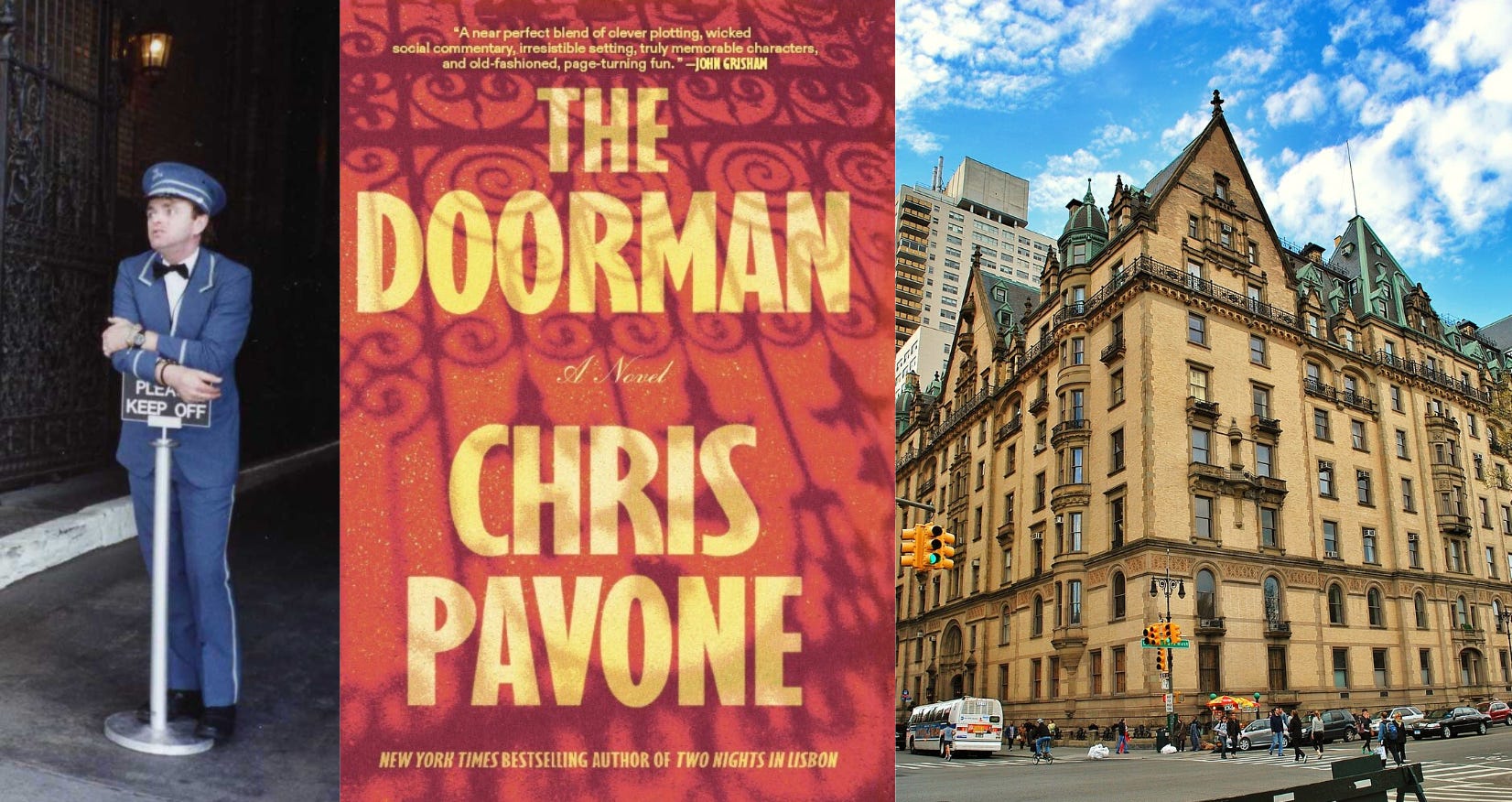
The Doorman is a thriller set in a semi-fictitious Upper West Side apartment building called The Bohemia. It’s really The Dakota—where John Lennon was shot in 1980— and where Pavone lives with his family today.
The building provides an aquarium-like lens through which to observe the creatures swimming in its tony waters—a microcosm of New York City and how it has changed. Fifty years ago, The Bohemia housed mostly artists, celebrated academics, and diplomats. Today, Pavone writes, “as with everything else in New York, the cultural class (has been) replaced with financiers.”
The intra-1% tension is one of many insightful threads woven into a pitch-perfect dissection of money, race, status, and politics in modern New York City. The comparisons to Tom Wolfe’s Bonfire of the Vanities are inevitable and intentional.
In the podcast that you are going to listen to and love, Pavone told me he set out to write a modern version of Bonfire, a New York crime novel that is “about racism, but also about class…which is often what we’re talking about when we talk about race.”
He brings it to life through his characters. There’s Chicky Diaz, the eponymous doorman who carries crushing medical debt while serving the building’s elite. Among them are the ethereal Emily Longworth and her husband, Whit, a sketchy billionaire with more money than taste.
But the most interesting conflict isn’t between rich and poor, it’s within the rich. Julian Sonnenberg, the Longworth’s art dealer, has cultural capital but fading finances. While he and Whit are neighbors, they definitely are not equals. And each of them is acutely aware of this.
Julian sums it up, “The corrosive thing about New York is that there’s always someone with more — more money, more fame, more power, more respect.”
Nobody needs to feel sorry for Julian, who is part of what Pavone calls the “normal rich,” like lawyers who take nice vacations and belong to a country club or two. They don’t worry about having cash for a taxi, but in NYC they do worry. About the billionaires above them. About being fired for saying something insensitive at work. About the $70,000 tuition at private schools, where teachers wear “Tax the Rich” t-shirts on parents’ day. About where their kids will go to college. Sure, Chicky’s girls got into Ivy League schools, but will Julian’s white children be given the same consideration?
Pavone asks many questions, but answers few. For all his diagnosing the ills of virtue-signaling, inequality, and racism, his politics remain opaque, much to the reader’s benefit. If we were to ascribe motives to the author, we would stop observing the characters and start judging them.
Instead, he just presents us with the aquarium and lets us watch the fish, to notice which ones are circling. And which ones are getting eaten.
THE END (but see comedy dates below ↓↓↓)
New Comedy Dates: Added San Francisco and L.A.!
May 3: Charlotte - Duckworth’s - ON SALE
May 7: Private School Comedy, West Side Comedy Club, NYC
May 20: Dunwoody Country Club (members and guests only)
May 21: Atlanta Punchline - ON SALE
May 22-23: DC Comedy Loft (tickets available soon)
June 4: Atlanta Athletic Club (members and guests only)
June 19-20: Comedy Catch, Chattanooga ON SALE
June 25: Couples Therapy Comedy at West Side Comedy Club, NYC
July 21: The Venice West, Los Angeles
July 23: Cobbs Comedy Club, San Francisco ON SALE
August 8: Atlanta Country Club (members and guests only)


