


Last week, I received a bill from New York City for $71,1783.16. It was the balance due for my Non-primary residence surcharge, aka the pied-à-terre tax that is a premium on top of the $55k or so we pay in regular, old fashioned property tax.
We got pinged because our home is owned by our trusts, which are not New York entities. The good news is that, since we are legit full-time residents, we will get out of this. Still, it’s pretty scary to get this kind of unexpected invoice.
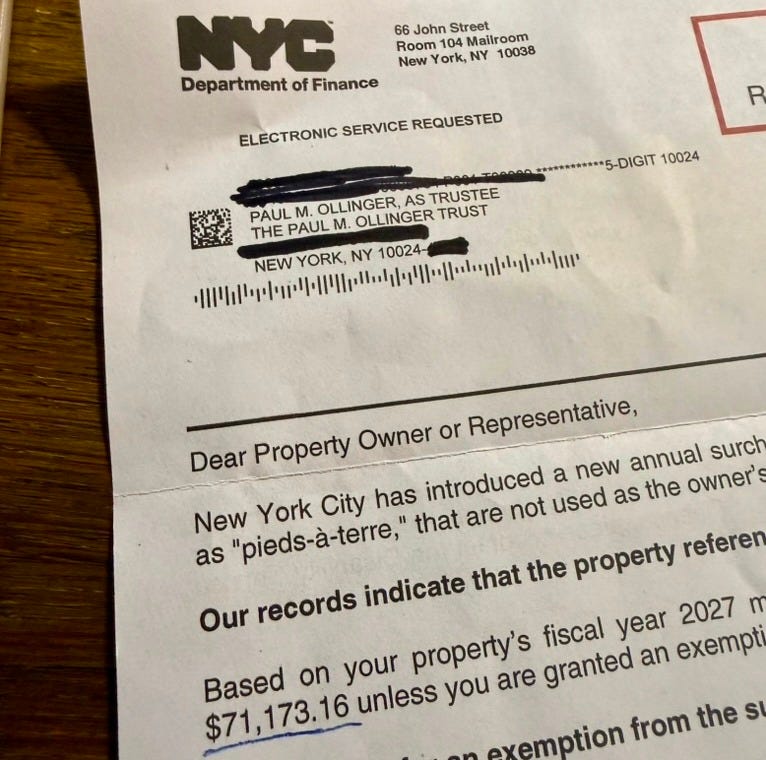
Suffice to say, it’s a wild time in New York city real estate. In addition to this new second—or third or fourth—home tax, there are a ton of policy changes in the works, including but not limited to:
The mayor and the Rent Guidelines Board just implemented a two-to-three year rent freeze for all the city’s rent stabilized units, comprising 41% of the supply of rental housing in the city.
Pending in the City Council is the Community Opportunity to Purchase Act (COPA) that, when it passes, will impose major restrictions on a multi-family unit owners’ freedom to sell their building.
Potential “Mansion” Tax reform could lower the threshold from $1 million to $500,000 transactions, increase rates by 40%, and switch the liability from the buyer to the seller.
In short, there’s a massive amount of uncertainty about the future, but all trends point to an increasingly hostile and expensive environment for property owners.
To try to make sense of how it works, I interviewed this week Paula Pant, founder and host of the Afford Anything podcast, a former newspaper reporter, and Knight-Bagehot Fellow at Columbia University.
Paula is a NYC-based landlord who has developed an expertise on the city’s rent stabilization system, where it came from, and how it works.
Most people assume that rent stabilization exists to help poor people, but that’s not the priority. It operates more like a lottery system where random, lucky “winners” lock in below-market prices regardless of how much money they make. In fact, a recent Wall Street Journal analysis indicated that more than 86,000 rent stabilized households earn over $200,000 a year!
The system and its adjacent policies protect bad tenants, disincentivize capital investment and construction, and have led to 57,000 vacant apartments because it’s less expensive to leave them empty than to participate in the city’s rigged game.
The whole thing is wacky and totally non-obvious. I learned a ton talking to Paula and I know you will too. Check it out.
Follow Paula on Instagram here, or X (aka, Twitter) here. Get your free download: 7 Expensive Rental Property Mistakes to Avoid
Follow Me (Paul) on Instagram here, or X (aka, Twitter) here.
Get tickets to see me live in Sarasota 8/13-16 here.
Timestamps
00:00:00 Trailer
00:00:59 Intro
00:03:03 Hyper frugal in her twenties, for all the wrong reasons
00:05:31 A $27,000 down payment on an Atlanta triplex
00:08:21 Never be a landlord in New York City
00:08:33 The price to rent ratio, and how to run it on any apartment
00:14:10 Nobody has a right to 12% returns, and what a 9.9% cap would actually do
00:16:24 Rent control versus rent stabilization: 16,000 units against a million
00:20:16 If it were designed to help poor people, there would be means testing
00:23:36 True working class people are subsidizing the rich
00:24:23 How the units actually get handed out, and the friend earning over $300,000
00:30:32 The Rent Guidelines Board, the 7 to 1 freeze, and the resignation in protest
00:37:07 Check credit or verify income, but not both
00:41:21 The 2019 law and the $100,000 turnover no bank will finance
00:49:25 57,000 vacant units and the Community Opportunity to Purchase Act
00:54:22 Austin as the model, and where Paula puts her own capital
00:57:13 Analyst, not advocate. Data over dogma
00:58:36 Outro


